 Atlantski Savet Srbije Dobrodošli na zvaničnu prezentaciju Atlantskog Saveta Srbije
Related Articles

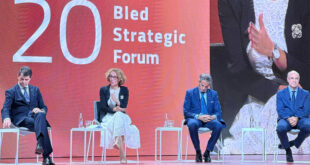

Vladan Živulović, president of the Atlantic Council of Serbia, holds rather different views, in line with the organization he represents. However, even in his perspective, there runs a common thread — that Serbia, above all, should put its own house in order before deciding “which empire to side with,” if it ever comes to that.
“Considering that Serbia has not officially aligned itself with any side in this multipolar world, at this moment it has no enemies, nor is any of these countries exerting significant pressure to change that. Belgrade is clearly trying to accommodate each of the mentioned countries — and I mean the U.S., Russia, China, and the European Union — as much as it can within its capabilities. Fortunately, their demands so far have not been such that they would lead to strained relations. We’ll see how long this situation can last. History doesn’t really support such a scenario,” Živulović told Ekspres.
Commenting on Professor Matthew Kroenig’s assessment that Serbia, in the geopolitical struggle among great powers, should consider the long-term consequences of cooperating with China — and that while it can maintain good relations with both the U.S. and China, deep strategic partnerships with both are unfeasible — Živulović says, “Professor Kroenig’s stance reflects the current state of affairs between these two major powers, a situation that has emerged with the re-election of the old-new president in the United States.”
“These relationships change depending on who leads the respective countries. The real question is whether the people leading Serbia actually want deep strategic partnerships with any country. So far, that hasn’t been demonstrated. What we’ve seen is a desire to maintain the best possible relations with every power. The question is, how long can that approach last, and which great power will be the first to demand a long-term strategic partnership from us. That’s when Pandora’s box will open — something we are all too familiar with since the time of the First Serbian Uprising and the struggle for freedom. We haven’t had the best experiences with these so-called ‘strategic partnerships,’” Živulović adds.
When asked whether the solution might be some sort of “third path,” with an uncertain shelf life, or if it’s wiser to choose a strategic partner, Živulović replies that “the third path hardly even exists.”
“I’m inclined to think that, after serious analysis of the power of the great powers, we should seek a long-term partner who can offer protection of our national interests — as a small and relatively poor country. Unfortunately, aside from the Načertanije, no Serbia has ever defined or drafted even a rough sketch of what our national interests are. The sequence should be: define the national interest — confirmed by referendum — and only then seek a long-term strategic partner, provided that doing so aligns with those national interests,” Živulović suggests.
And when asked who, in the current situation and according to his own preferences, he would want as Serbia’s strategic partner, he answers:
“The current global situation is very turbulent. America, under its new leadership, wants to redefine its global role; the European Union is clearly in crisis; Russia is bogged down in a war it initiated, with economic problems; and China is also in a mild recession. It’s hard to believe that anyone has the time or capacity to focus on Serbia. For the time being, I wouldn’t deal with strategic partnerships — I’d focus on putting my own house in order. Our home is not in great shape,” Živulović concludes.
Author: Marko R. Petrović
Source: www.ekspres.net
Full article HERE.